How the AI Judges Every Rep
REPPED's scoring isn't a black box or a marketing exaggeration — it's a real computer-vision pipeline running in your browser. Here's exactly what it does, in plain language.
1. Pose estimation: mapping your body to a skeleton
The moment your camera turns on, an on-device pose-estimation model (Google's MediaPipe Pose Landmarker) maps your body to 33 key points — shoulders, elbows, wrists, hips, knees, ankles, and more — many times per second, directly from your video feed. This runs as WebAssembly inside your browser, using your device's GPU where available. Nothing is uploaded to a server for this step.
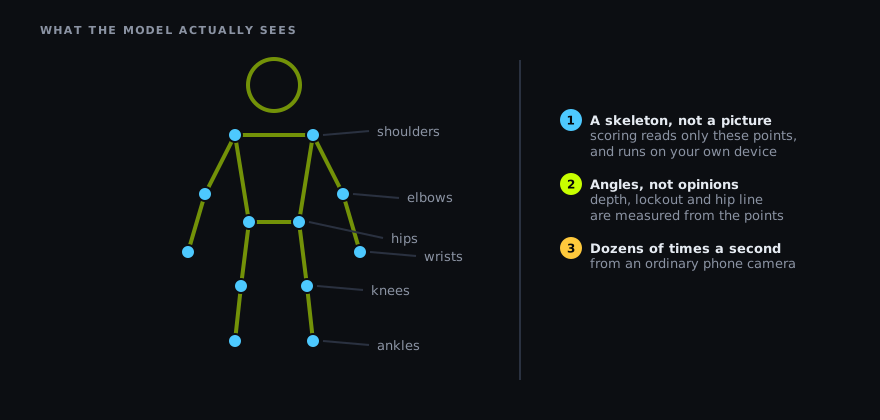
2. Per-exercise analysis
Each exercise has its own analyzer that watches for the specific joint angles and body positions that define a valid rep:
- Push-ups — elbow bend depth, chest proximity to the floor, and full lockout at the top.
- Squats — hip-to-knee depth (breaking parallel) and standing all the way up between reps.
- Burpees — a complete stand → floor → stand cycle; partial cycles don't count.
- Plank — hip alignment held in a straight line for the full duration, not rep count.
A rep that stops short of full depth, or an elbow that doesn't fully lock out, is measured against your own body proportions in the frame — not a fixed camera-angle-dependent number — and is flagged as incomplete rather than silently counted.
3. Visibility and effort tracking
The system continuously checks how much of your body is visible and in-frame. If visibility drops too low for too long, the analyzer can't reliably judge your reps and the match reflects that. Separately, it tracks motion energy across key joints throughout the 30 seconds — being in active motion for a healthy share of the battle is what full effort credit is based on. Standing still for most of the clock and bursting for the last three seconds scores worse than steady, consistent work, exactly as you'd expect from a fair judge.
4. The final score
Your rep count (or hold time for plank), form quality, pacing, and effort combine into a single score from 1 to 10 for that match. Hitting the target rep count for an exercise with clean form is what a perfect 10 represents — the target varies by exercise since a burpee and a push-up demand very different paces.
Three pages on this site send you here for “the full formula”, so here it is, rather than a description of one. Each of the five components comes out of the battle as a number between 0 and 1, and they are combined with fixed weights:
- 40% reps — how close you got to the target count for that exercise (or the target hold, for plank).
- 25% form — how many of those reps reached full depth and full lockout, against the thresholds above.
- 15% speed — your pace against the pace the exercise expects — a burpee and a push-up are not judged on the same clock.
- 15% consistency — whether the reps kept an even rhythm or came in one burst and a long gap.
- 5% effort — how much of the 30 seconds you spent actually moving, measured from joint motion.
The weighted total, still between 0 and 1, is stretched onto the scale you see: score = 1 + total × 9, rounded to one decimal. So the floor is 1, not 0 — turning up and being visible is worth something.
One override sits on top of it. If you were properly visible for less than half the battle, the match is flagged and the score is capped at 2 no matter what the components say, because at that point the system was not measuring you well enough to hand out a good one.
5. What happens when the camera can't see you well
Poor lighting, an unusual camera angle, or stepping out of frame all degrade what the model can measure. Rather than guessing, REPPED's analyzers are built to flag low-visibility periods explicitly, and a lightweight motion-based fallback engine takes over automatically on older devices or browsers where the full pose model can't load — so a match never silently breaks, it degrades gracefully.
6. Where this runs, and why that matters for privacy
All of the above happens on your device. Your camera frames and body-position data never leave your browser for scoring — only the final numeric result (score, rep count, exercise) is ever sent to our servers, and only for signed-in players who want their Elo saved. During a live 1v1 match, video streams peer-to-peer directly to your opponent; our servers relay connection signaling only. Full details are in our Privacy Policy.
Honest limitations
This is camera-based pose estimation, not a certified biomechanics lab. It isn't a medical device, it can be thrown off by extreme lighting or camera angles, and — like any client-side system — a determined bad actor can attempt to interfere with it. We don't claim otherwise. What we do build in: plausibility checks on submitted results, rate limiting, and a reporting system for suspected abuse. See our Anti-Cheat and Fair Play pages for exactly how that works, and what to do if you think an opponent gamed the system.
Related reading
- How Elo rating works
- The full battle walkthrough
- How AI is changing fitness — the broader context on our blog