The Psychology of Friendly Competition — Why We Try Harder When Someone's Watching
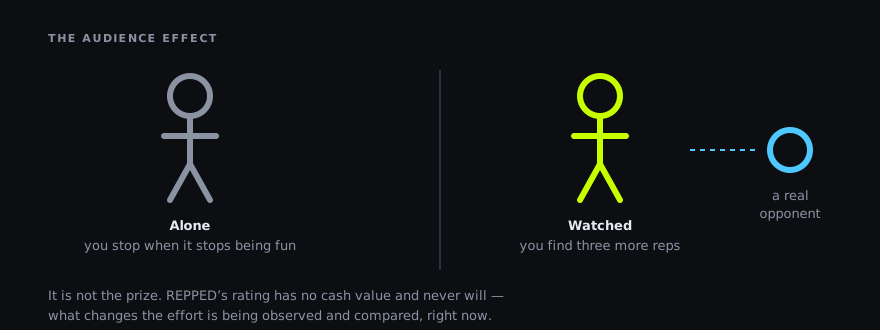
Psychologists call it social facilitation: people perform simple, well-learned physical tasks better when others are present, especially when there's an evaluative or competitive element. Push-ups, squats, and burpees are exactly this kind of task — no complex decision-making, just execution under pressure. That's why a stranger on camera can pull more effort out of you than an empty room ever will.
It's not about winning
The effect holds even when the stakes are trivial. It's not really about the prize — REPPED's Elo has no cash value and never will — it's about being observed and compared in the moment. Losing an Elo point stings slightly more than a private failed rep count ever could, and that slight sting is enough to change behavior.
Why 'friendly' still works as competition
You don't need real stakes for competition to be motivating — you need a real opponent and a real result. That's why casual games, pickup sports, and yes, 30-second AI-judged push-up battles, produce genuine effort even when nothing tangible is on the line. The brain doesn't distinguish 'friendly' from 'serious' nearly as much as it distinguishes 'watched' from 'alone.'
Why it only works on movements you already know
There is an important limit on the audience effect, and it is the part usually left out. Being watched improves performance on tasks you have already learned, and it degrades performance on tasks you have not. The presence of an audience raises arousal, and raised arousal amplifies whatever your dominant response to a task already is. If your dominant response is competent, you get better. If you are still working out what you are doing, you get worse.
This is why a 30-second push-up battle is a good candidate and a first attempt at a complex barbell lift is a terrible one. You already know how to do a push-up. There is no decision to make under pressure, only execution, so the extra arousal has nowhere to go except into effort.
It also means the effect is not a shortcut around learning a movement. If your squat form is unreliable on your own, competing will not fix it; it will produce faster, worse squats. Learn the movement alone until it is boring, then add the opponent.
Advertisement
The stakes can be almost nothing
What surprises people most is how little the stakes have to be. A rating with no cash value, held on a website, in a game nobody in your life has heard of, is enough to change how many repetitions you find. That seems irrational until you notice that the same thing happens in every pickup game ever played, none of which have prizes either.
The mechanism is not the reward. It is that a result exists, someone else saw it, and it is now a fact rather than a private impression. A number you generated alone can be quietly reinterpreted — you were tired, the floor was awkward, it was not really a proper attempt. A number generated against someone else cannot be renegotiated after the fact, and knowing that in advance is what changes the effort.
The version of this that goes wrong
Competition curdles in two specific ways, and both are worth naming because both are avoidable. The first is when the gap is too large. Being beaten badly by someone far above your level produces nothing useful — no information, no motivation, just the accurate observation that you are not them yet. Rating-based matchmaking exists to prevent this, and it is the main argument for it over a simple queue.
The second is when losing costs more than winning gains. If a defeat means public humiliation, or a comment section, or a permanent mark, people protect themselves by not playing. This is why competitive formats built for consistency tend to have no chat, small rating swings and no way to leave a message on someone's profile. The result should be the only thing your opponent gets to say to you.
Using this on purpose
- Train with a partner or opponent whenever the option exists — even virtually
- Make your result visible immediately, not after a delay
- Pick an environment with light stakes (a rating, a streak, a leaderboard spot) rather than none at all
- Rotate opponents — novelty keeps the audience effect from fading
See it in action
This is the entire mechanism REPPED is built around: a live camera, a real opponent, a 30-second window, and an immediate, public result. Check the leaderboard to see the effect at scale, or read how matches are scored to understand exactly what's being judged.
Advertisement
About the author
Gonzalo Sánchez-Cervera
Gonzalo Sánchez-Cervera builds REPPED on his own: the pose detection, the rep counting, the site you are reading. He is 15, trains bodyweight, and every threshold described on this blog was tuned against footage of his own push-ups, squats, burpees and planks. When an article gives a number, it is a number he measured.