Calisthenics for Beginners: Where to Actually Start
Search 'calisthenics' and you'll get a wall of one-arm pull-ups and human flags. That's the ceiling of the discipline, not the floor — and mistaking one for the other is why a lot of beginners quit in week two, frustrated that they can't do what a five-year veteran can do.
The floor of calisthenics is push-ups, squats, and planks done with real attention to form. That's genuinely it. Everything more advanced is a progression built on top of those basics being solid first.
Start with quality, not quantity
A beginner doing 8 clean, full-depth push-ups is in a better position than one doing 20 half-reps. Quality reps build the strength and motor pattern that later let you add reps, tempo, or harder variations safely. This is also exactly how REPPED scores — form and depth matter as much as raw rep count.
The three things beginners get wrong
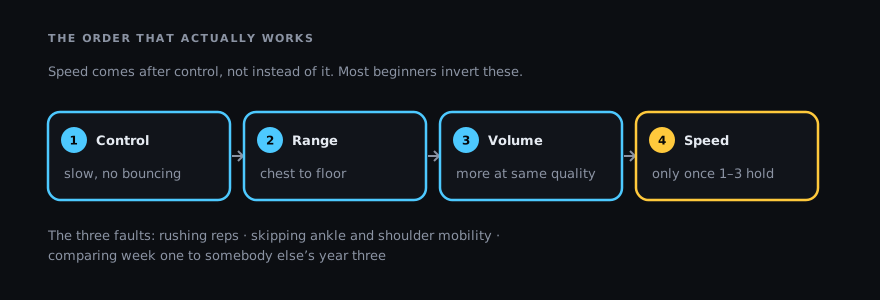
- Rushing reps instead of controlling them — speed should come after control, not instead of it
- Skipping mobility work, especially ankles (for squats) and shoulders (for push-ups)
- Comparing week-one performance to someone else's year-three performance
What to do when you cannot do one yet
A large number of people cannot do a single full-depth push-up, and almost every beginner guide quietly skips past this, which is how it manages to be discouraging in its first paragraph. Not being able to do one is an ordinary starting point, not evidence that you are unusually unfit.
The move is not to do bad push-ups. It is to do good push-ups at an easier angle. Hands on a kitchen counter, then a chair seat, then a low step, then the floor. The movement is identical at every height — same elbow angle, same straight line from heel to head, same full range — and only the fraction of your bodyweight changes. Because the pattern is the same, everything you build transfers directly when you drop to the next height.
Squats have the same ladder. Sit back to a chair and stand up, then to a lower seat, then to nothing. Planks have it too: on your knees, or with your forearms raised on a sofa, before the full version on the floor. In every case you are doing the real exercise, correctly, at a load you can control — which is precisely what everybody means by good form.
Advertisement
The mobility that actually blocks people
Two restrictions are behind most beginner squat and push-up problems, and neither is strength.
The first is ankle dorsiflexion — how far your knee can travel forward over your toes with your heel down. If it is limited, your heels lift or your torso pitches forward as you descend, and you will be told to fix your form by people who cannot see that your form is being dictated by your ankle. Kneel with one foot forward and push the knee gently past the toes, heel glued down, thirty seconds each side, most days. It moves faster than people expect.
The second is thoracic extension — how well your upper back opens. If it is stiff, the shoulders round forward and a push-up starts loading the shoulder joint in a position it does not like. Lying back over a rolled towel placed across the upper back, arms overhead, for a minute or two, addresses most of it.
Neither of these is exciting and neither takes long. They are, however, the difference between form cues that work and form cues that just make you feel clumsy.
How long things actually take
The first four to six weeks of any new training produce improvements that are mostly neurological rather than muscular. Your nervous system gets better at recruiting the muscle you already have — better coordination, better timing, less involuntary bracing against yourself. This is why beginners often add several repetitions in a fortnight and then seem to stall.
The stall is not a plateau. It is the point at which the easy neurological gains have been collected and the slower business of actually building tissue takes over. Knowing that in advance is genuinely useful, because the stall arrives at almost exactly the moment the novelty wears off, and the two together are what ends most beginners' attempts.
Expect a fast start, expect it to slow, and do not treat the slowdown as a verdict on you.
A realistic first month
Week 1–2: focus entirely on form at low reps — 3 sets of whatever clean number you can hold together, twice a week per movement. Week 3–4: start adding reps or a few seconds to your plank hold, still prioritizing form over speed. By the end of the month, most beginners see a genuine, measurable jump — which is a good moment to test yourself against someone else instead of just a stopwatch.
Make it social
Calisthenics is usually a solo pursuit, which is part of why it's easy to abandon. Adding a live, camera-on 1v1 element — where an AI scores form and effort in real time — gives beginners something a private mirror never will: a reason to show up today specifically. Check the exercises REPPED battles rotate through, or read how the Elo rating system works before your first match.
Advertisement
About the author
Gonzalo Sánchez-Cervera
Gonzalo Sánchez-Cervera builds REPPED on his own: the pose detection, the rep counting, the site you are reading. He is 15, trains bodyweight, and every threshold described on this blog was tuned against footage of his own push-ups, squats, burpees and planks. When an article gives a number, it is a number he measured.