Thirty Seconds Is a Different Exercise
The first time most people do a 30-second REPPED battle, they are surprised by how badly it goes. They know they can do thirty push-ups. They get eighteen, and their arms feel strange in a way a normal set never produces.
That is not a fitness problem. A 30-second maximum-effort set is a genuinely different exercise from a set of the same movement done at a normal pace, and it is worth understanding why before you decide you are unfit.
You are running on a different fuel
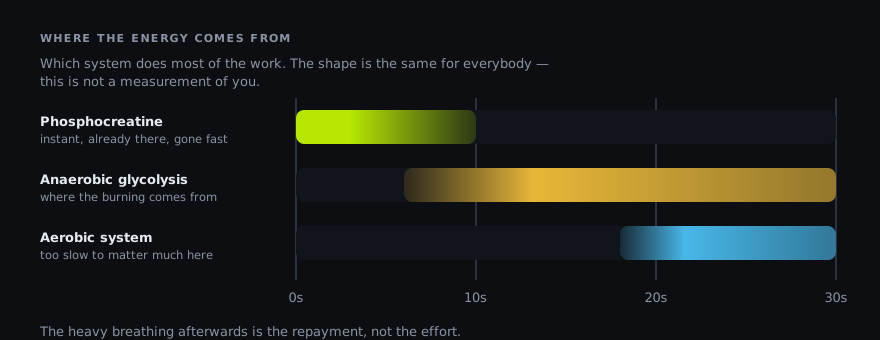
For roughly the first ten seconds of an all-out effort, your muscles run mostly on phosphocreatine — energy already sitting in the muscle, available instantly, and gone almost as fast. It is why the first five reps feel free.
After that, and for most of the remaining twenty seconds, you are running on anaerobic glycolysis: fast, powerful, and producing metabolic byproducts faster than your body can clear them. That burning, heavy feeling at second twenty-two is the byproduct arriving, not your muscles failing.
Your aerobic system — the one that actually has stamina — barely gets involved. It is too slow to contribute meaningfully inside half a minute. Which means a 30-second set does not test the fitness most people have been training.
Why you gasp afterwards, not during
The heavy breathing after a 30-second set is not you catching up on the oxygen you needed during it. You barely used any. It is your body repaying the debt: restocking phosphocreatine and clearing what glycolysis left behind.
This is why the recovery matters more than the set. Two minutes of standing still restores a large fraction of that phosphocreatine. Thirty seconds does not. If you do three battles back to back, the third one is measuring your recovery, not your strength.
What the battle screen shows you while it happens
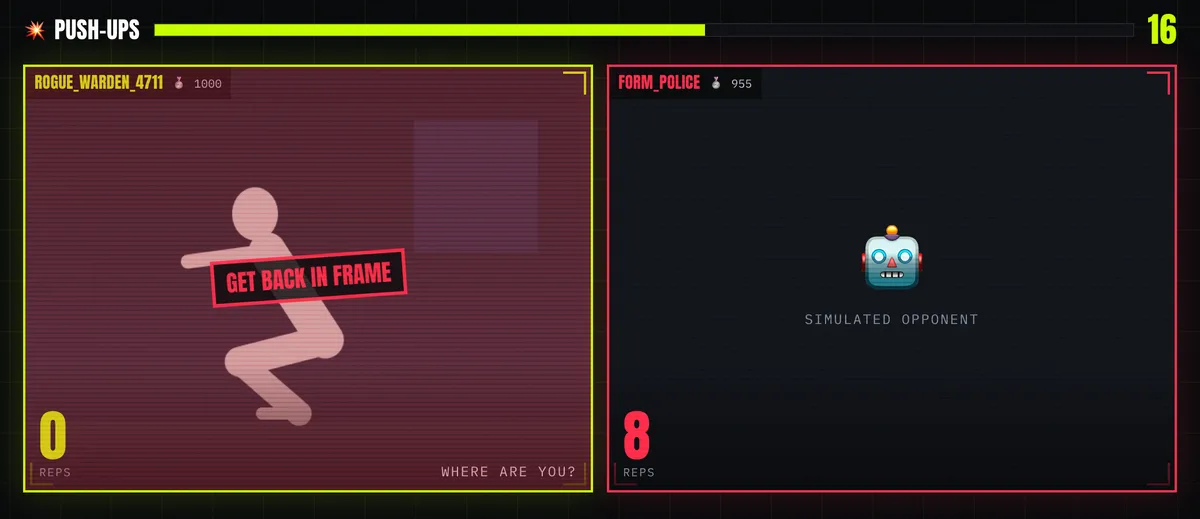
The battle screen is built around that curve. A bar runs across the top from thirty down to zero, and it turns red for the last five seconds, which is exactly when glycolysis is making every repetition cost the most. Your counted repetitions sit in the bottom corner of your own camera, your opponent's in theirs, so you can see whether you are ahead without looking away from your own form for long.
What the screen deliberately does not show is a running score. The 1 to 10 number only exists once the thirty seconds are over, because it depends on form, speed and consistency across the whole set, and a live score would tempt you into exactly the sprint-and-collapse pacing this article is warning you about.
Advertisement
How to actually pace it
- Do not sprint the first ten seconds. The free energy runs out either way, and burning it in a blur costs form, which costs counted reps.
- Pick a rhythm you could hold for the full thirty and start there. Almost everyone starts faster than they can hold and loses more to the collapse than they gained.
- Full range from the first rep. Half reps do not count, so a fast shallow rep is worth literally nothing while costing real energy.
- Rest properly between battles. Two minutes is not being soft; it is the difference between measuring strength and measuring fatigue.
Why your first battle is always your worst
There is a reliable pattern in first attempts: people go out far too fast, hit a wall somewhere around second eighteen, and finish with a number well below what they are capable of. Then they conclude they are unfit.
What has actually happened is a pacing failure, and it is nearly universal because you have no reference for this duration. Thirty seconds is too short to feel like an endurance effort and too long to sprint, and almost everyone defaults to sprinting. The first ten seconds feel effortless, which they are — that is the free phosphocreatine — and the feeling is deeply misleading about what the next twenty will cost.
The practical consequence is that the improvement between your first and third attempt is mostly pacing, not fitness. That is worth knowing so you neither despair at the first number nor take too much credit for the third.
The number you should compare yourself to is your own
A 30-second rep count is heavily influenced by things that have nothing to do with training: limb length, bodyweight, how much sleep you got, how warm you are, what time of day it is. Comparing your raw number to a stranger's is comparing two measurements taken with different instruments.
Compared against your own previous numbers, taken under roughly the same conditions, it becomes a genuinely good metric — sensitive enough to move within a couple of weeks and immune to the slow, noisy behaviour of something like bodyweight.
This is also, incidentally, the argument for a rating rather than a raw score on a public board. A rating asks how you did against the people you actually met, which quietly cancels out most of what the raw number cannot control for.
Where this format fits in real training
Half a minute of maximum effort is a legitimate stimulus. It trains the anaerobic system, it trains repetition speed and it trains the ability to hold technique while uncomfortable, all of which are real and all of which transfer.
What it does not do is build endurance, and it does not build maximal strength either — it sits between the two and touches neither properly. Doing only 30-second efforts and expecting to get better at long sets is a specific and fairly common mistake.
The useful way to hold it is as the thing that keeps you attached to training on days when nothing else would happen. Thirty seconds needs no warm-up, no plan and no decision. Some weeks it is the whole of your training and that is far better than the alternative; most weeks it is the doorway to the rest of it.
What this format is good for
Thirty seconds is short enough that nobody needs to schedule it, warm up for it, or dread it. That is the whole point of the format: it is startable at any energy level, which makes it something you actually repeat.
But be clear about what it measures. A 30-second score is a snapshot of power and technique under a very specific constraint. It is not the same as your endurance, and improving it will not automatically improve your ability to do long sets. If you want both, you need to train both — this is the one you can do in a doorway before school.
Advertisement
About the author
Gonzalo Sánchez-Cervera
Gonzalo Sánchez-Cervera builds REPPED on his own: the pose detection, the rep counting, the site you are reading. He is 15, trains bodyweight, and every threshold described on this blog was tuned against footage of his own push-ups, squats, burpees and planks. When an article gives a number, it is a number he measured.